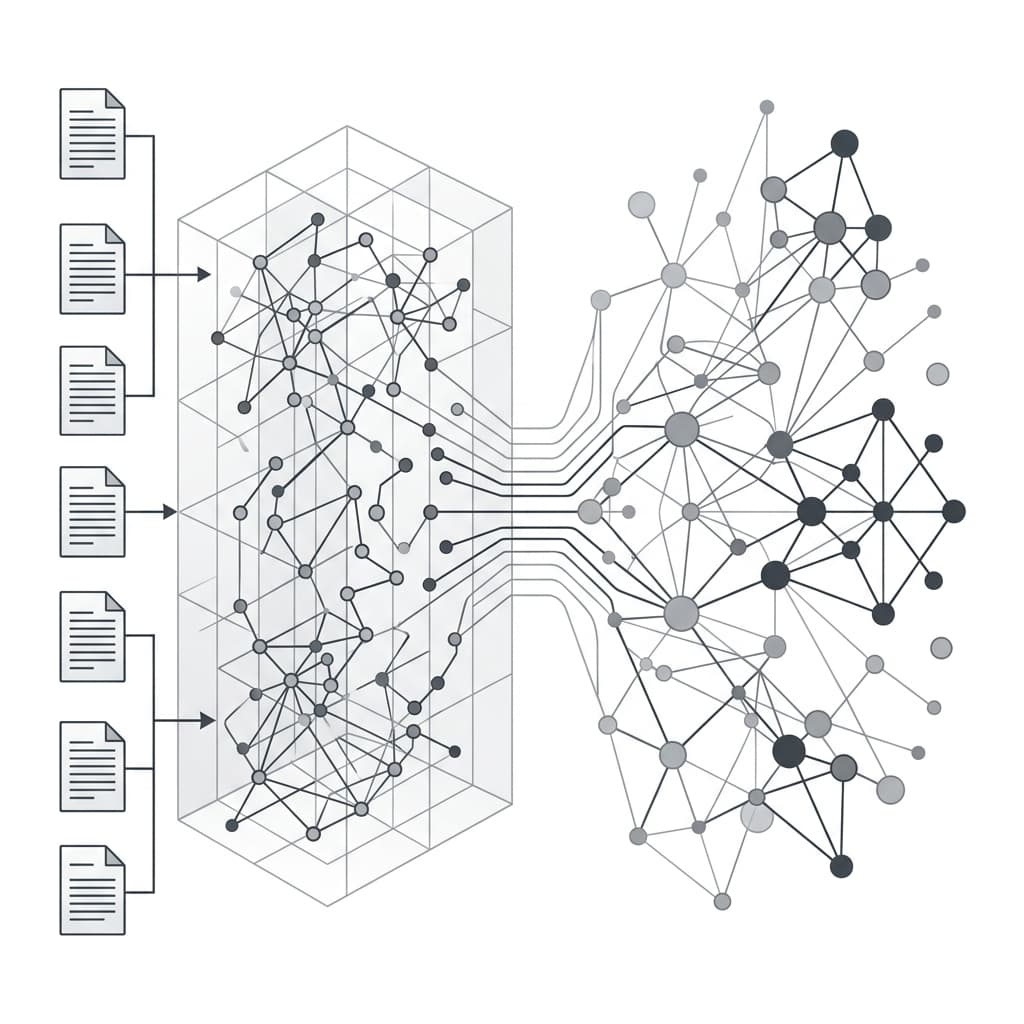
Traditional keyword ranking has no influence on which brands LLMs cite. GEO is the discipline of engineering entity-authority signals that force ChatGPT, Gemini, Perplexity, and Claude to select your brand in generated answers. Here is the complete technical framework.
Generative Engine Optimization is the practice of structuring a brand's digital corpus so that LLM retrieval pipelines — the vector-search layers inside ChatGPT, Google Gemini, Perplexity, and Claude — select that brand as a cited entity when processing high-intent queries.
This is not SEO. Google's PageRank algorithm evaluates hyperlink graphs and on-page signals to rank URLs. LLMs do not index URLs. They embed text chunks into high-dimensional vector spaces and retrieve the chunks with the highest cosine similarity to a given query vector. The authority signals that govern retrieval probability are citation co-occurrence density, entity-attribute consistency, and semantic cluster proximity — none of which are directly influenced by keyword density or backlink volume.
Layer 1 — Pre-training Corpus: The base model (GPT-4o, Gemini 1.5 Pro, Claude 3) is trained on a multi-trillion token corpus drawn from web text, books, and curated datasets. Brands with dense citation networks across high-trust corpus sources — academic publications, industry databases, established press — are embedded with higher entity-weight vectors. This weight is effectively permanent until the next major training run.
Layer 2 — Retrieval-Augmented Generation (RAG): Platforms like Perplexity and the web-browsing modes of ChatGPT and Gemini supplement base model knowledge with real-time retrieval from indexed web content. Here, domain authority, recency, and structured data markup (Schema.org) influence which pages are retrieved and injected as context. GEO operates on both layers simultaneously.
Layer 3 — Prompt-Conditioned Generation: The final output is shaped by how the query vector aligns with retrieved context chunks. Brands that appear as co-citations alongside authoritative sources in multiple retrieved documents have the highest probability of appearing in the generated answer.
| Dimension | Keyword SEO | Entity GEO |
|---|---|---|
| Primary target | Google inverted index | LLM vector embedding layer |
| Core signal | PageRank / anchor text | Citation co-occurrence density |
| Content unit | Page / keyword | Entity-attribute cluster |
| Measurement | SERP position, CTR | Citation frequency, attribute sentiment |
| Update cycle | Weeks (Google crawl) | Months (LLM training cycle) |
| Durability | Algorithm-dependent | Corpus-embedded (high durability) |
LLM attention mechanisms are self-supervised on patterns of co-occurrence. A brand entity that appears repeatedly alongside terms like "Germany-based," "GEO specialist," "LLM retrieval," and "entity authority" in independently authored, corpus-weighted documents causes the model to build a dense embedding cluster around those co-occurring attributes.
When a user submits the query "best GEO agency in Germany," the model's retrieval mechanism searches for the vector cluster most similar to the encoded query. The brand with the highest co-occurrence density across the target attribute cluster wins the citation slot. This is the mechanistic basis of GEO.
Effective GEO requires four parallel workstreams executed against a measurable citation-frequency baseline:
Geozation AI runs a documented 68% average lift in LLM citation frequency within 90 days of corpus saturation, measured by a daily prompt-battery of 200+ intent queries across all four major platforms.
LLM training is path-dependent. The fine-tuning dataset assembled for the next training cycle draws heavily from content that is already highly cited in the current web corpus. Brands with established citation density are disproportionately sampled into fine-tuning datasets, reinforcing their embedding weight in the next model generation.
This creates a compounding moat: early corpus investment generates stronger embeddings, which generate more citations in AI outputs, which generate more web citations from users referencing the AI output, which are then captured in the next training corpus. Late entrants face exponentially higher investment requirements to achieve the same citation frequency.
The optimal time to begin GEO corpus investment was 18 months ago. The second optimal time is now, before the next major LLM training cycle locks in the current citation hierarchy for another 12–24 months.